
A Review of Paradise in Ashes: a Guatemalan Journey of Courage, Terror, and Hope
Paradise in Ashes: a Guatemalan Journey of Courage, Terror, and Hope
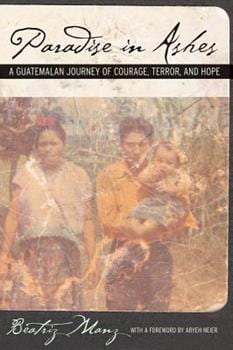
Paradise in Ashes: a Guatemalan Journey of Courage, Terror, and Hope By Beatriz Manz Berkeley: University of California Press, 2004
Traditionally, anthropologists have divorced themselves emotionally and physically from their subjects, placing the highest priority on objectivity and the role of the anthropologist as expert observer, while often neglecting or de-emphasizing the potential for advocacy that anthropologists may have, particularly those who work with populations in which torture, genocide, or other human rights violations may be occurring.
Current concerns over the ethical ramifications of observing without intervening in populations where these violations are present have made ethnographic work in vulnerable groups a difficult task, one in which the ideal balance of the roles of observer and advocate is difficult to ascertain and even more difficult to achieve.
Few anthropologists in the United States have provided personal examples of how to manage the ethical and professional issues inherent in working with communities in crisis, and very few have used their vantage point as researchers to advocate for and educate others on a broader level about the on-going tragedies their work encounters.
Providing this example is Beatriz Manz, a recent speaker at Harvard and an anthropologist at the University of California-Berkeley, whose latest work, Paradise in Ashes, is an intense, detailed account of the atrocities of the civil war in Guatemala in the 1980s. This work gives Manz a distinct place among a small handful of other notable books describing an observer’s perspective on modern-day genocide.
The culmination of her 20+ years working and living in the highland village Santa Maria Tzejá, Paradise in Ashes is not only perhaps the most detailed longitudinal account of the civil war but also provides a sterling example of an optimum balance of advocacy and ethnographic analysis in the face of human tragedy.
Manz, Chilean by birth and influenced by the coup of the Pinochet era, shows the reader through well-done ethnographic analysis how the war marches on through generations of Guatemalans born to Santa Maria Tzejá, the first village visited by the Ejército Guerrillero de los Pobres (EGP), or the Guerilla Army of the Poor, and a central site of conflict and army intervention during the war.
Throughout the book, Manz unflinchingly details not only the immense loss of life that the villagers endured throughout the war but also those whom she lost as well, dedicating the book in part to Myrna Mack, a friend and Guatemalan anthropologist who who was murdered by the military for her ‘subversive’ activities organizing Guatemalan women’s groups.
Manz’s straightforward perspective on the war, coupled with her excellent analyses, gives the reader a rare and intimate perspective on Guatemalan politics, one rarely seen in other foreigner-penned accounts of the Guatemalan civil war. Particularly well-done is Manz’s account of the creation and settlement of Santa Maria Tzeja in the 1970s. In the chapter, “Settling in the Promised Land,” Manz discusses the arduous journey, personal sacrifices, and immense work that the village’s future inhabitants put forth in order to settle what they had presumed to be an inconspicuous, relatively worthless bit of rain forest so that they might have land and a better future for their families.
Her account of the hope and optimism with which the villagers raised up Santa Maria Tzejá, assisted in part by Catholic organizations such as Maryknoll and church groups, not only poignantly frames the horrid story of war to come but also encapsulates the local setting for much of the Guatemalan civil war, where Indian villages, Catholic priests and nuns, and church groups of all descriptions became targets for the government’s war against its own people.
Also notable is her account of the army’s “re-building” of Santa Maria Tzejá in her chapter “A Militarized Village”. After its destruction by the army, government forces, in an effort to control the nearly annihilated indigenous population, invited new settlers to Santa Maria Tzejá to replace those villagers who had fled to Mexico, creating tensions between the village’s previous settlers, the antiguos, and the new settlers or nuevos; Manz describes not only these tensions but the solidarity eventually achieved between antiguos and nuevos despite the original intent and the army’s psychological and physical control of Santa Maria Tzejá during that time.
Paradise in Ashes is deeply engaging in part due to the compelling, emotionally gripping and often horrific subject matter and also due to the personal perspective from which Manz occasionally relates. Using clear, objective, and direct language, Manz also provides appropriate ‘remedial history’ for those who, for whatever reason, may not have been cognizant of the extremes of this particular era in Guatemala and showcases the political and social forces at work in the creation, destruction, and eventual rebirth of Santa Maria Tzejá. Manz’s own efforts to be an accurate and ethical witness are also detailed as Manz describes her own personal actions in the light of the activist groups, reporting “disappearances” and murders to the often-unconcerned authorities, or writing editorials and articles to broadcast the Guatemalan army’s reign of terror, showcasing the author’s own delicate negotiations between advocacy and academia.
Finally, Paradise in Ashes makes an enormous impact as a first-hand observer’s account of perhaps one of the largest-scale genocides in Latin American history since the first “settlement” of the Americas. The details of Manz’ personal journey as anthropologist, advocate, and friend to the people of Santa Maria Tzejá also make a significant contribution to public anthropology as a guide for those who might seek to integrate political activism and advocacy into their academic inquiries. With skill, sensitivity, and a trained eye, Manz expounds not only on the tragedy resulting from the 36-year long civil war in Guatemala but, importantly, also the intricate web of social and political factors contributing to it. She thus gives academia and a broader audience alike a foundation for future work in Guatemala as it continues to arise from two decades of terror and repression.
Fall 2004/Winter 2005, Volume III, Number 1
Tarayn A. Grizzard is a 4th-year medical student pursuing a combined MD/MPH program at the Harvard Medical School and the Harvard School of Public Health. A recent intern at the Universidad de Chile’s CEMERA (Centro de Medicina Reproductiva y Desarrollo de la Adolescencia) clinic in Santiago, her research interests include adolescent medicine and cultural aspects of women’s health in Latin America.
Related Articles

A Review of Bodies Found in Various Places
This bilingual anthology of Elvira Hernández, translated by Daniel Borzutzky and Alec Schumacher and published by Cardboard House Press, offers a comprehensive entry point into the work of the Chilean poet. The translators’ preface offers a valuable introduction that provides important context to her work and explains aspects of her poetry present in the volume, such as Hernández’s self-effacing “ethics of invisibility,” an ars poetica in which the poems stand in front while the poet hangs back, in a call to observe rather than to be observed. In this sense, Hernández has long written from the edges of Chile’s public life, partly by choice, partly by necessity: her birth name is Rosa María Teresa Adriasola Olave, but she adopted the pseudonym of Elvira Hernández under the Pinochet dictatorship.

A Review of An Ordinary Landscape of Violence
When first reading the title, An Ordinary Landscape of Violence, I asked myself if there is really anything “ordinary” about a landscape of violence? Preity R. Kumar argues that violence is endemic to Guyana’s colonial history and is something that women loving women (WLW) contend with and resist in their personal and public lives.

A Review of Lula: A People’s President and the Fight for Brazil’s Future
André Pagliarini’s new book arrives at a timely moment. During the summer of 2025, when the book was released, the United States began engaging in deeper debates about Brazil’s political situation. This shift was tied to the U.S. government’s decision to impose 50% tariffs on Brazilian products—the highest level ever applied to another country, matched only by India. In a letter to President Lula, Donald Trump’s administration justified the measure by citing a trade deficit with Brazil. It also criticized the South American nation for prosecuting one of Washington’s ideological allies, former president Jair Bolsonaro, on charges of attempting a coup d’état. Sentenced by Brazil’s Supreme Court to just over 27 years in prison, the right-wing leader had lost his 2022 reelection bid to a well-known leftist figure, Lula da Silva, and now stands, for many, as a global example of how a democracy can respond to those who attack it and attempt to cling to power through force.

