Latin American Revolutionaries and the Arab World
Latin American and Arab Revolutionaries
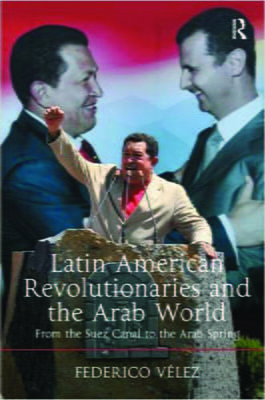
Latin American Revolutionaries and the Arab World by Federico Vélez (Burlington, VT: Ashgate, 2016, 198 pp.)
The presence of an Arab diaspora in Latin America is reasonably well known. Step forward Shakira!
But relations between Latin America and the Arab World have not been well covered in the literature; let alone more specific relationships among revolutionaries. Step forward Federico Vélez, also a Colombian, teaching at Zayed University, UAE.
In writing this book Vélez is open about his objectives: to tell “…the story of a series of encounters between Latin American and Arab revolutionaries as part of the broader global history of the twentieth century and beyond.”
And “… to contribute to the debate regarding the ideological and political autonomy of those actors on the periphery of the international system by arguing that these actors have been far more independent in their actions and political convictions than we had previously assumed.”
Vélez has undertaken some original research (as would be expected of a book drawing on a doctoral thesis at the Tufts University Fletcher School of Law and Diplomacy). Even so, the author rightly gives a summarized version of events such as the Cuban Missile Crisis to provide context to his main focus: the interaction of Latino and Arab revolutionaries.
Most space is given to storytelling. Vélez writes well. And he also paints on a large canvas: the Cuban Revolution and Egypt; Algeria and Cuba; the Cuba-Nicaragua and Palestinian Movements of 1968-89; Venezuela and the Arab World. That’s more than a fifty-year time span—from the Suez Canal crisis to the Arab Spring.
The storytelling is often illuminating. A colleague of Gamal Abdul Nasser recalls a number of meetings between Che Guevara and Nasser in the period from 1959 to 1965. Neither their first nor last meeting went well. Why? Because one was a convinced, somewhat romantic revolutionary and the other a somewhat pragmatic leader who had gained his “revolutionary credentials” by nationalizing the Suez Canal. This difference came through in their last meeting.
In March 1965 Guevara explained to Nasser that he was going to the Congo to help the revolution: “I have revolutionary activities and organization and I think the situation is ripe in Africa.”
And the reply: “You astonish me…I don’t want to interfere, but if you want to be another Tarzan, a white man coming among black men, leading them and protecting them…It can’t be done.”
As Vélez admits, Nasser was correct. The Cuban intervention turned out to be a complete failure.
At the same time, Vélez shows that there was some substance to, for example, Cuban and Algerian cooperation. The Cubans sent military help to Algeria in 1963 while Algeria was embroiled in a border dispute with Morocco. In return, the Algerians acted as a conduit for Cuban arms being sent to Argentina and Venezuela during the 1960s.
The difficulty is that despite his best efforts, Vélez can’t show that there was a great deal of substance to the relationship between Latino and Arab revolutionaries. Yes, there was certainly much mutually supporting public rhetoric by leaders such as Fidel Castro and Hugo Chávez on the one side, and Nasser and Ahmed Ben Bella on the other. But as I know from my own diplomatic experience, such words are more often pro forma than necessarily meaningful.
A case in point is Hugo Chávez. I knew Hugo Chávez fairly well during the early years of his presidency. He was an intelligent leader with that crucial ingredient called vision (whether you shared it or not). Chávez knew that a Venezuelan, Juan Pablo Pérez Alfonso, had been one of the founding fathers of the Organization of Petroleum Exporting Countries (OPEC) in 1960. In 2000 Chávez travelled to the Middle East to meet all those heads of state whose countries were OPEC members. His motivation at the time, as he explained to me, was pragmatic. He wanted to hold only the second-ever OPEC Summit in Venezuela and raise the price of oil. It worked.
Subsequently, as Vélez shows, Chávez used his success with that OPEC summit to build a deeper relationship with certain Arab leaders. But Chávez’ initial foray into the Middle East was basically about oil and talking to all OPEC heads of state, revolutionaries and conservatives. In that context, were the rhetorical outpourings of the later years of the Chávez presidency in praise of certain radical Arab leaders as important to them and him as raising the price of oil?
Underlying this assumption is the question that Vélez neither asks nor answers. Who are the revolutionaries? How has he chosen them? The book would have been better if he had spelled out how and why he chose these specific “revolutionaries,” some of whom were elected democratically and others not.
And what of the second objective of the book?
Here, I admit to being somewhat perplexed. In my view it is rather jargon-ridden and unclear in its meaning. How does one prove that some states on the periphery (defined in Cold War terms) had more independence than “… we had previously assumed (undefined)”? In any case, it could not apply to Chávez, who came to power many years after the end of the Cold War. Vélez correctly notes that during the Cold War Cuba had rather more freedom of maneuver than most Eastern European states in relation to the Soviet Union. Otherwise and fortunately, not much of the book is devoted to answering this rather woolly question.
Notwithstanding these points, Vélez has written a useful, readable book, looking at relationships that have remained unexplored for a long time. In that sense, it is an addition to scholarship.
John Hughes is Visiting Professor in Practice and Board member of the London School of Economics’ foreign policy think tank, LSE Ideas. Previously, he was a member of the British Diplomatic Service for 35 years including serving as Ambassador in Venezuela and in Argentina.
Related Articles

A Review of Authoritarian Consolidation in Times of Crisis: Venezuela under Nicolás Maduro
What happened to the exemplary democracy that characterized Venezuelan democracy from the late 1950s until the turn of the century? Once, Venezuela stood as a model of two-party competition in Latin America, devoted to civil rights and the rule of law. Even Hugo Chávez, Venezuela’s charismatic leader who arguably buried the country’s liberal democracy, sought not to destroy democracy, but to create a new “participatory” democracy, purportedly with even more citizen involvement. Yet, Nicolás Maduro, who assumed the presidency after Chávez’ death in 2013, leads a blatantly authoritarian regime, desperate to retain power.

A Review of Las Luchas por la Memoria: Contra las Violencias en México
Over the past two decades, human rights activists have created multiple sites to mark the death and disappearance of thousands in Mexico’s ongoing “war on drugs.” On January 11, 2014, I observed the creation of a major one in my hometown of Monterrey, Mexico. The date marked the third anniversary of the forced disappearance of college student Roy Rivera Hidalgo. His mother, Leticia Hidalgo, stood alongside other families of the disappeared organized as FUNDENL in a plaza close to the governor’s office. At dusk, she firmly read a collective letter that would become engraved in a plaque on site. “We have decided to take this plaza to remind the government of the urgency with which it should act.”

A Review of A Promising Past: Remodeling Fictions in Parque Central, Caracas
A beacon of modern urban transformation and a laboratory of social reproduction, Parque Central in Caracas is a monumental enclave of 20th-century Venezuelan oil-fueled progress. The monumental urban structure also symbolizes the enduring architectural struggle against entropy, acute in a country where the state routinely neglects its role in providing sustained infrastructural maintenance and social care. Like other ambitious modernizing projects of the Venezuelan petrostate, Parque Central’s modernity was doomed due to the state’s dependence on the global oil economy’s cycles of boom and bust.

