A Review of The Colombia Reader: History, Culture, Politics
Historical Voices, New Perspectives
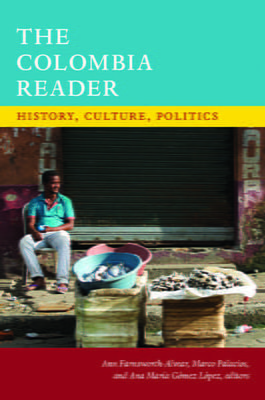
Ann Farnsworth-Alvear, Marco Palacios, and Ana Maria Gómez López, eds., The Colombia Reader. History, Culture, Politics (Durham: Duke University Press, 2017)
Fifteen-plus years ago, historian David Bushnell argued in his widely read textbook that Colombia was the least studied and probably the least understood major country in Latin America. The Colombia Reader will contribute much to solve this problem, while also placing Colombia at the center of historical understanding of Latin America as a region. It represents part of a historiographical shift in the way histories of Colombia are told. This impressive selection of historical documents—lyrics, poems, novels, historiographical reflections, cartographic descriptions, photo essays, interviews, art pieces, developmental programs—will become an essential teaching tool for anyone teaching about Colombia.
Facing the challenging task of what to include or exclude, the editors decided to integrate a fluid chronological organization with a quite perceptive thematic structure. The book thus examines questions of human geography, religion, city and country, lived inequalities, violence, and economic change and continuity across five centuries. A multiplicity of historical voices from nearly every conceivable ethnic/racial group, class position, social group, cultural construction, and political formation invites readers to put those actors in dialogue with one another in order to explain struggles for power and the consolidation of specific forms of domination.
As I went about the admittedly tough task of reading all of this voluminous book, I began to imagine multiple ways of how to use these documents in the classroom: reading Joe Arroyo’s lyrics about “perpetual slavery” to discuss racial identities as well as narratives of slave rebellions, for instance, or assigning interviews with paramilitary leaders to understand neoliberal rule. This is perhaps the element that readers will appreciate the most because, although the editors contextualize for every document collected here and in so doing sometimes resort back to familiar tropes about Colombian history, there is also a clear effort to leave the presentation of those documents as open-ended questions. In that sense, the book intentionally and intellectually provokes the reader to think new narratives and interpretations of the histories of Colombia.
As Herbert Braun writes in his book endorsement, The Colombia Reader will allow people from Colombia to be historically understood alongside their fellow Latin Americans. I cannot emphasize how important this is. Colombia is too often cast as a singular, indeed unique, political place in both its hemisphere and even the broader world. The task is to connect more carefully local histories—and here the examples offered in the Reader are quite rich—with “big” questions or metanarratives. This book’s documents can consequently be utilized not to prove some putative uniqueness of Colombian history, but rather to probe larger historical problematizations of colonialism, liberalism, populism, modernization, violence, peace, immigration, emigration, and political economies from coffee to flowers to cocaine. Histories of Colombia can accordingly contribute to the understanding of larger questions, thus avoid the methodological and theoretical reflex to nationalize, or even regionalize, historical narratives.
This book will allow us to write, teach, and tell not only different histories of Colombia but to write, teach, and tell those histories differently. Instead of arriving at different answers to the same questions that historians have posed during the last three decades about Colombia’s past, this book convinced me that we need new questions so as to get different narratives of that past.
The publication of the Reader is also quite timely, as it invites us to avoid getting too comfortable with a teleological understanding of what is now called la era del posconflicto, in which violence is understood as it was in the past while peace is imagined in the present and future. Indeed, the documents compiled here are reminder that peace is not in opposition to power or domination but rather its contested product. This collection will certainly become a foundational teaching tool not only for the histories of Colombia but also those of Latin America.
Fall 2017, Volume XVII, Number 1
A. Ricardo López is associate professor of history at Western Washington University. He is author of The Makers of Democracy. A Transnational History of the Middle Classes in Bogotá, 1958-1982 (Duke University Press, forthcoming); and co-editor of The Making of the Middle Class. Toward a Transnational History (Duke University Press, 2012).
Related Articles

A Review of Authoritarian Consolidation in Times of Crisis: Venezuela under Nicolás Maduro
What happened to the exemplary democracy that characterized Venezuelan democracy from the late 1950s until the turn of the century? Once, Venezuela stood as a model of two-party competition in Latin America, devoted to civil rights and the rule of law. Even Hugo Chávez, Venezuela’s charismatic leader who arguably buried the country’s liberal democracy, sought not to destroy democracy, but to create a new “participatory” democracy, purportedly with even more citizen involvement. Yet, Nicolás Maduro, who assumed the presidency after Chávez’ death in 2013, leads a blatantly authoritarian regime, desperate to retain power.

A Review of Las Luchas por la Memoria: Contra las Violencias en México
Over the past two decades, human rights activists have created multiple sites to mark the death and disappearance of thousands in Mexico’s ongoing “war on drugs.” On January 11, 2014, I observed the creation of a major one in my hometown of Monterrey, Mexico. The date marked the third anniversary of the forced disappearance of college student Roy Rivera Hidalgo. His mother, Leticia Hidalgo, stood alongside other families of the disappeared organized as FUNDENL in a plaza close to the governor’s office. At dusk, she firmly read a collective letter that would become engraved in a plaque on site. “We have decided to take this plaza to remind the government of the urgency with which it should act.”

A Review of A Promising Past: Remodeling Fictions in Parque Central, Caracas
A beacon of modern urban transformation and a laboratory of social reproduction, Parque Central in Caracas is a monumental enclave of 20th-century Venezuelan oil-fueled progress. The monumental urban structure also symbolizes the enduring architectural struggle against entropy, acute in a country where the state routinely neglects its role in providing sustained infrastructural maintenance and social care. Like other ambitious modernizing projects of the Venezuelan petrostate, Parque Central’s modernity was doomed due to the state’s dependence on the global oil economy’s cycles of boom and bust.

