A Review of Reagan’s Gun-Toting Nuns: The Catholic Conflict over Cold War Human Rights Policy in Central America
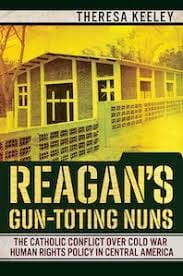
Reagan’s Gun-Toting Nuns: The Catholic Conflict over Cold War Human Rights Policy in Central America, by Theresa Keeley (Ithaca: Cornell University Press, 2020. 334 pp.).
First let’s get the book’s regrettable title out of the way. In eighteen years of covering the wars in Central America as a reporter, I never knew of a female religious who was a “gun-toting nun.” In Reagan’s Gun-Toting Nuns: The Catholic Conflict over Cold War Human Rights Policy in Central America, author Theresa Keeley doesn’t quote anyone using the term because, as she admits in her introduction, “No person uttered the phrase.” Rather, the author combined “nuns” with “gun-toting,” she writes, in an attempt to stress “how entangled Catholic debates about the meaning of Catholic identity were with those about U.S.-Central America policy.” The juxtaposition shocks; it might draw readers, but it also invites scandal, is unclear and unjust.
Beyond its title, Keeley’s book is an important and absorbing read, set in the 1980s with deep resonance for our day. In its pages the fine and ever-shifting line between religion and politics receives a fascinating, exhaustively researched, and necessary examination at a time when the U.S. Catholic Church is being drawn ever further to the right, its most conservative bishops in league with fundamentalist white evangelicals and wealthy supporters to re-shape the country based on their version of Christianity. Keeley’s focus on a key historical moment in which women of the Maryknoll order affected the struggle over U.S. Central America policy and the unity of U.S. Catholicism, the largest religious institution in the country, throws light upon the era when the church’s rightward shift began.
Ronald Reagan showed that he knew the power of the churches when, as the Republican presidential candidate in 1980, he told a huge gathering of the Southern Baptist Convention, “Religious America is awakening.” He incorporated ultraconservative Catholics in his cabinet and among advisors during two terms. Having supported abortion legislation as governor of California, Reagan reversed himself as president to oppose it, thrilling conservative Catholics and white fundamentalist evangelicals, and as Keeley describes, even presented himself as a defender of Pope John Paul II against imagined attacks from liberal Catholics. Influenced by what they saw and heard on the ground in war-torn Central America, or knew from those who had worked there, those “liberal Catholics” often embraced the progressive liberation theology, maligned as “Marxist” by ultraconservatives for some of its analytical tools and concern for the poor. Many Maryknollers and others familiar with the region regarded the impoverishment and repression of the destitute majority in El Salvador, Guatemala, Honduras and Nicaragua as the cause of civil conflict and armed resistance, while Reagan viewed the Central American wars through the Cold War lens as the work of international communism.
Maryknoll, the only U.S. Catholic mission order, with male and female members, was known and respected by, among others, generations of U.S. school children – I was one of them. They came home to raise funds, but also told stories of faith and evangelization in distant lands, bringing the wide world closer, giving us the idea that Catholics had a connection to people in other countries, baptized or not. By the 1980s, when Maryknollers had shifted from unquestioningly accepting U.S. foreign policy and converting “pagans” to accompanying those they served in their daily lives, priests and nuns practiced “reverse mission” by continuing to educate U.S. Catholics, including through their long-time, eminently readable magazine, and through Orbis Books, founded in 1970 by the U.S.-born Nicaraguan Maryknoll priest Miguel D’Escoto. Orbis introduced many Americans to liberation theology. Maryknollers communicated to everyday Catholics as well as to U.S. lawmakers the realities they saw among the poor in Latin America – the indignities of being without jobs or education, premature death, but also nascent understanding that their misery was not the will of God.
In 1980 U.S.-supported troops in El Salvador brutally murdered four U.S. churchwomen: Ita Ford and Maura Clarke were Maryknoll sisters; Jean Donovan had been trained as a lay missioner at Maryknoll in New York state; Dorothy Kazel was an Ursuline nun. After the event, the fault line between conservative Catholics who supported Reagan, and those who did not, widened into a chasm that arguably remains today, and marked the beginning of an ideological war over Central America that lasted for much of the decade. “No other foreign policy issue was so visceral or so polarizing,” wrote Reagan’s chief of staff James Baker about the period’s war of ideas over the region in his book, The Politics of Diplomacy. Keeley, assistant professor of U.S. and the World at the University of Louisville, illustrates how Reagan purposefully reached out to Catholics to support him. She quotes a range of their responses, including from those who equated the president’s crusade in the region with a war against godless communism and defended it in various ways. An example: During 1987 hearings when testimony emerged about the National Security Council (NSC) operation to skirt Congress and secretly support Nicaraguan counter-revolutionaries, NSC member Col. Oliver North, who was raised Catholic, admitted to shredding compromising documents, while White House communications director Patrick Buchanan used Catholic moral framework against North’s critics, mocking their “moral horror” over the shredding when “4,000 unborn children are daily shredded in the abortuaries [sic] of the United States.” But Keeley also shows how testimony and citizen activism by Maryknoll nuns fruitfully confronted the administration about supporting the armed Contra forces that Reagan and the CIA created to bring down the revolutionary Sandinista government in Nicaragua, and they clarified for many the facts of the conflict in El Salvador. Importantly, Keeley highlights the gender bias inherent in attacks on Maryknoll nuns that branded them childlike, naïve, “useful idiots” incapable of understanding the greater political picture. The powerful Speaker of the House of Representatives, Democrat Tip O’Neill, a Reagan opponent, was tarred with the same brush, with challenges to his masculinity because he paid close attention to the Maryknoll nuns’ information and assessments. “The Reagan-O’Neill Central America policy debates overlapped with and influenced debates among Catholics over the Cold War, U.S. foreign policy, the church’s direction, and the role of nuns—and women generally – in the church,” Keeley observes.
I question the author’s simplistic characterization of Maryknollers Thomas Melville and Margarita Bradford Melville as individuals who “advocate(d) violence;” the Melvilles have published detailed accounts of their complex paths of discernment in Guatemala. The Guerrilla Army of the Poor, for one, they said, was founded on the principle of self-defense. For many Christians like the Melvilles, the decision of men and women to take up arms was a legitimate response to brutal state violence and acute repression, all other options had been exhausted, and victory was a reasonable expectation, thus meeting the conditions for a “just war” set forth in Catholic moral theology. And while I appreciate the spotlight on Maryknoll to tell a compelling story of religious who stood up for human rights in Central America (to the point that Keeley avers that “Maryknoll came to represent all resistance to Reagan administration policy”), I longed for just a bit more recognition of dioceses – I think of San Francisco, Cleveland, and Oklahoma City among others – and orders that sent religious to the region in response to the call of Pope John XXIII, like the martyr Stan Rother, an ordinary diocesan priest; the Christian Brother James Miller, also murdered in Guatemala, and others who escaped assassination by a hairsbreadth. These observations should not discourage the reader from picking up Keeley’s book, which is an achievement not only on its own merits, but also because there is nothing else quite like it, interweaving the consequences of powerful faith among a remarkable group of women with the politics of a tumultuous time.
Mary Jo McConahay is the author of the forthcoming Playing God, American Catholic Bishops and the Far Right (Melville House).
Related Articles

A Review of Megaprojects in Central America: Local Narratives About Development and the Good Life
What does “development” really mean when the promise of progress comes with displacement, conflict and loss of control over one’s own territory? Who defines what a better life is, and from what perspective are these definitions constructed? In Megaprojects in Central America: Local Narratives About Development and the Good Life, Katarzyna Dembicz and Ewelina Biczyńska offer a profound and necessary reflection on these questions, placing local communities that live with—and resist—the effects of megaprojects in Central America at the center of their analysis.

A Review of Authoritarian Consolidation in Times of Crisis: Venezuela under Nicolás Maduro
What happened to the exemplary democracy that characterized Venezuelan democracy from the late 1950s until the turn of the century? Once, Venezuela stood as a model of two-party competition in Latin America, devoted to civil rights and the rule of law. Even Hugo Chávez, Venezuela’s charismatic leader who arguably buried the country’s liberal democracy, sought not to destroy democracy, but to create a new “participatory” democracy, purportedly with even more citizen involvement. Yet, Nicolás Maduro, who assumed the presidency after Chávez’ death in 2013, leads a blatantly authoritarian regime, desperate to retain power.

A Review of Las Luchas por la Memoria: Contra las Violencias en México
Over the past two decades, human rights activists have created multiple sites to mark the death and disappearance of thousands in Mexico’s ongoing “war on drugs.” On January 11, 2014, I observed the creation of a major one in my hometown of Monterrey, Mexico. The date marked the third anniversary of the forced disappearance of college student Roy Rivera Hidalgo. His mother, Leticia Hidalgo, stood alongside other families of the disappeared organized as FUNDENL in a plaza close to the governor’s office. At dusk, she firmly read a collective letter that would become engraved in a plaque on site. “We have decided to take this plaza to remind the government of the urgency with which it should act.”

