
A Review of Stranger in the Desert: A Family Story
Young adults traveling to find themselves is a tale as old as time. It’s not hard to conjure images of historical figures or folk heroes sailing out for adventure, looking for fame, fortune or—perhaps more important—meaning. They usually sail to the unknown, but in Stranger in the Desert, writer Jordan Salama retraces the steps of his great-grandfather—hoping to learn more about the mysterious man who brought the Salama clan from Syria to America.
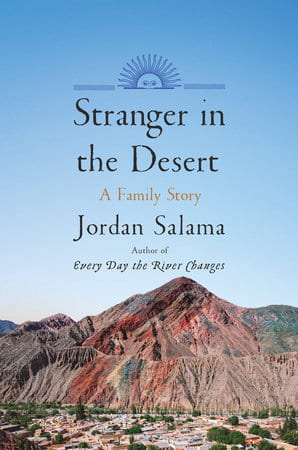
Stranger in the Desert: A Family Story by Jordan Salama (Penguin Random House, 2023)
Selim Salama, a traveling salesman, started his journey in Syria in 1911 under what can only be described as disputed circumstances: some believe he sailed to South America to avoid a military draft; others that he got into a feud that put his life in danger; yet nothing is conclusive (when it comes to certain aspects of Selim’s life, nothing truly is). He then arrived in Argentina, though few can agree on the details of his time there: too many tales surround his life. In Argentina, Selim traveled throughout the land, selling wares away from Buenos Aires, his new home, only to return to the city with some money to spend and many stories to tell.
Jordan Salama, three generations later, finds himself in his grandparents’ New York basement, catching a glimpse of what his traveling salesman great-grandfather did—and, more importantly, what he may have done. Turco (what men of Middle Eastern descent were called in most of Latin America) traveling salesmen were known for doing what they could to survive and to enjoy themselves on their travels. Fueled by rumors and thirst for adventure, the young writer travels to Argentina to retrace his great-grandfather’s steps, the steps of a man who may have fathered more children than previously thought— folks unaware of their ancestry. Jordan travels to Argentina to find what he calls the “lost Salamas.”
The author is not without help: his grandfather collected everything that has to do with their family—from Selim’s time to Jordan’s—in one volume called Historia Antigua (Ancient History). That book’s full of handwriting, typed notes, encyclopedia articles, newspaper clippings and more, becoming the roadmap Jordan uses to retrace the history of a man known for his bravado and bombast.
In Argentina, Jordan too finds help from other known descendants of Selim Salama who stayed in the country, unlike his branch of the family, who emigrated to the United States. Many share stories, while some refuse to believe what they call tall tales. Tall tales or not, the author travels to the north of the country to find out the truth. He spends a wonderful evening with a modern traveling salesman who loves his job, very much like he supposes Selim did in his time; he finds himself confronting the nasty side of Argentine thought against Turcos, gypsies, Jews and anyone traveling to make a living; and he also spends a few days with a gaucho, an Argentine cowboy figure most see only in books. By experiencing the good, the bad and the ugly of the country his great-grandparent walked and experienced, Jordan Salama shapes a newfound Argentine identity.
Each chapter sets the scene to discover a different part of Argentina, full of different characters with different stories to tell—but all of them are connected by a thread that joins Jordan and Selim, two people born in distant lands, living in distinct eras; united, perhaps, in their love for telling a good story.
As Jordan traces back his ancestor’s footsteps, he finds out that his great-grandfather often traveled the same route other Turcos did in his time. Multiple people from different provinces are glad to welcome Jordan into their home to share a little bit of their family history that, at times, seems to echo Selim’s—and Jordan’s.
Jordan’s writing is simple yet eloquent: he writes not to take over but to allow the reader to experience Argentina and its colorful characters, making you feel like you’re traveling alongside Jordan instead of hearing him tell tales about a distant place. At times, you are left with the feeling that some of the stories told are not fully fleshed out – that, perhaps, a young Jordan (the author wrote this book before publishing his previous one) didn’t have the journalistic experience to push forward when things don’t go his way: halfway through the book, Jordan faces someone freely expressing racist remarks about Turcos, and he decides not to engage and walk away instead of going further to find out why they think like that. In contrast, when Jordan engages with someone he likes, he’s at his best—like when he spends time with a friendly traveling salesman or relives family stories with his grandfather.
His grandfather—one of Selim’s many children who, unlike most of his siblings, decided to pursue a career in medicine instead of a life in sales—brushes with famous Argentine figures, studying medicine in the same year as Ernesto Guevara, the famous Argentinian revolutionary, and, like Guevara, he dreamed of a revolution that never came to their land. El Che went to Cuba to pursue his revolution, while El Negro (the nickname Jordan’s grandfather received because of his dark, curly hair) left for the United States to pursue a life away from political violence.
His grandmother also brushes with Argentine history by being saved from being stranded in Israel during tough times, thanks to a letter written to Eva Perón. Jordan’s grandmother, also a central figure in this story, often recalls her past with joy and grief, recognizing the power and problematic nature of nostalgia, which makes us remember our history and mourn its differences with today.
Stranger in the Desert is a book about the power of nostalgia, the roots of family history and the surprises the past has in store – and the way they shape the present. Jordan travels to look for long-lost relatives in Argentina, only to learn he is the Argentine man missing in his grandfather’s book. It’s a travelogue that puts emphasis on people rather than places, a transcript of a baptism by fire of Argentine living, featuring a young Jordan Salama who experiences the best and the worst the country has to offer, ultimately realizing that he finds himself in a place that he can call his own.
Juan Albandoz is a freelance writer from Argentina.
Related Articles

A Review of Live From America: How Latino TV Conquered the United States
The story of Spanish-language television in the United States has all the elements of a Mexican telenovela with plenty of ruthless businessmen, dashing playboys, sexy women, behind-the-scenes intrigue and political dealmaking.

A Review of The Power of the Invisible: A Memoir of Solidarity, Humanity, and Resilience
Paula Moreno’s The Power of the Invisible is a memoir that operates simultaneously as personal testimony, political critique and ethical reflection on leadership. First published in Spanish in 2018 and now available in an expanded English-language edition, the book narrates Moreno’s trajectory as a young Afrodescendant Colombian woman who unexpectedly became Minister of Culture at the age of twenty-eight. It places that personal experience within a longer genealogy of Afrodescendant resilience, matriarchal strength and collective struggle. More than an account of individual success, The Power of the Invisible interrogates how power is accessed, exercised and perceived when it is embodied by those historically excluded from it.

A Review of Negative Originals. Race and Early Photography in Colombia
Negative Originals. Race and Early Photography in Colombia is Juanita Solano Roa’s first book as sole author. An assistant professor at Bogotá’s Universidad de los Andes, she has been a leading figure in the institution’s recently founded Art History department. In 2022, she co-edited with her colleagues Olga Isabel Acosta and Natalia Lozada the innovative Historias del arte en Colombia, an ambitious and long-overdue reassessment of the country’s heterogeneous art “histories,” in the plural.

