
About the Author
E-mail: baluizeti@gmail.com Twitter: @BLuizeti
Brazilian Science under Attack
The growing influence of negativist movements that disseminate false information and pseudoscience has seriously influenced Brazilian response to the pandemic. A good part of the population—even my own friends and family— discredited in the preventive measures essential such as masks and social distancing for the control of the spread of the disease. They also are adamant defenders of “early treatment” with medications such as ivermectin and hydroxychloroquine.
About two weeks ago, I went to visit my aunt and uncle who were sick with Covid-19. When I arrived at their house, I asked them to tell me what treatment the doctor had prescribed, and the answer was high doses of ivermectin, hydroxychloroquine, vitamin C and zinc, that is, the “complete cocktail against Covid-19,” so famous among ill-informed and reckless doctors in Brazil. It was difficult to explain to them that this treatment was wrong, that it would not work and that it could also cause serious side effects. It required a lot of courage and tact because a medical student going against a doctor’s conduct is a complicated situation and often seen as a confrontation.
Indeed, even some health professionals with access to reliable data disseminate fake news about Covid-19 treatments and precautions. I clearly see the effect of this inconsistency on a daily basis, when people close to me no longer know whom to believe in. With people confused by contradictory and often false information, the effectiveness of public health measures advocated by respectable health organizations and scientists is greatly diminished.
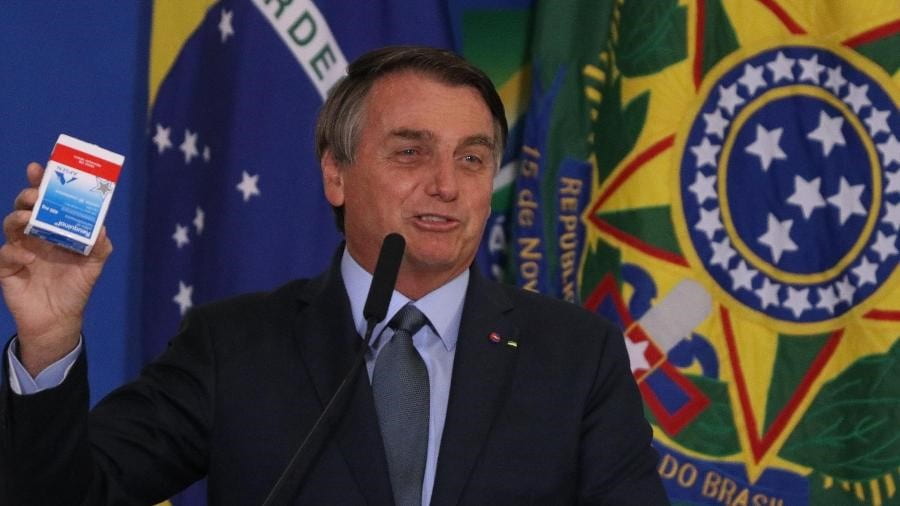
President Jair Bolsonaro said in a live broadcast that Covid-19 has early treatment and encourages the use of hydroxychloroquine (January 14, 2021).
Fighting this negative wave are scientists and researchers, and I include myself in this group, who try to combat fake news with consistent information on a daily basis. We reached the point of having to explain epidemiology, scientific methodology and calculations of effectiveness on Twitter to the lay public, in order for them to believe in us. There are times when I feel hopeless about the future of science in Brazil. Even with arguments and evidence, the fight against pseudoscience is arduous and daily and we often do not obtain the necessary visibility.
Through sharing and retweeting, we can reach people’s levels, influencing attitudes and decisions that can affect the health of the community where we live. In this context, a #DontBeFake campaign was created, disseminated on several social networks, essentially on Twitter. This hashtag sought to draw attention to the importance of generating scientific evidence to guide the decision-making process of governments, health agencies and scientific authorities in the face of this pandemic, while highlighting the importance of sharing of classified, verified information and official sources, fighting against infodemic and false news that we are confronted with on a daily basis.

Often, questionable articles without peer review or substantial research overwhelm the quality articles. What worries me most is the amount of articles and pre-prints, with weak methodology and multiple biases, which confuse some researchers and the population in general. It is evident that the scientific ecosystem, based on the mass production of articles, influences this amount of waste in research. Therefore, it was clear to everyone that something must be done to reduce the spread of this false or misleading data.
I am currently developing an analysis of the articles related to Covid-19. Meta-research enters this scenario to assess how mass production of articles and peer reviews made by journals in shorter periods to expedite publications on the topic influence the outcome of the reports and impact on the scientific community.
Today, open access to data allows assessing the reliability and reproducibility of studies. So why do scientists still suffer so much from ideological or political attacks? Some specific groups with an anti-science bent, strengthened by the sector of the lay population that believes in the information disseminated, account for some of these attacks. In addition, Brazilian science has been diluted by political bias, assuming that the cuts in funds for research development are becoming higher each semester. As an example, I cite the current struggle of several scientists and entities, such as the Brazilian Society for the Progress of Science and the Brazilian Academy of Sciences, to combat the vetoes of the president of the republic that prevent the release of resources from the National Fund for Scientific and Technological, responsible for financing scientific and technological innovation projects in Brazil.
As a student in a health course, I see that the critical evaluation of the data received is not very stimulated in Brazilian academic circles. Many of us are taught to memorize information about anatomy, histology and physiology, but when we come across a scientific article, we are not taught to evaluate whether the data is reliable or even to give our critical opinions on what we have read. Furthermore, in the absence of a critical sense, part of the problem in question arises. Now, academics in the health field can also spread fake news on their social networks.
To make matters worse, President Jair Bolsonaro himself, since the beginning of his administration in 2019, disseminates fake news. In March 2020, the president referred to Covid-19 as a “flu” and, in April 2020, declared that there were signs that the pandemic was ending. In addition, the Ministry of Health, a federal agency that historically has always based its declarations on scientific evidence, recently advocated a measure that was proven to be ineffective, the so-called “early treatment.” Today, Brazil is the second country with the most deaths from Covid-19 and the third with the most cases worldwide.

President Jair Bolsonaro with members of the brazilian army without wearing a mask (January 21, 2021).
Another aspect I would like to comment on is the anti-vaccine movement. As a Brazilian, I was always proud to be able to go to my local health clinic and update my vaccination card. Brazil has always been one of the countries that could be proud of its national immunization program, completely conceived and implemented by the national government. In my head it has always been and should be.
But a few years ago, the anti-vaccine movements increased their influence in my country. False theories about adverse and life-threatening effects have been circulating. Today some claim that the vaccine against Covid-19 turns the patient into a crocodile. These are unimaginable distortions, but the population is afraid, which leads to reduced adherence to vaccination.
At a time when scientific evidence should prevail in the fight against Sars-Cov-2, attention is shifting to the struggle of different political ideologies. On social media, I see direct attacks of a political and ideological nature against scientists. Without political support, and with a government that does not support scientists, there is a growing reduction in the population’s confidence in science; everyone loses in this context. As Professor Pedro Hallal, “SOS Brazil” already said, we need help.
More Student Views

Puerto Rico’s Act 60: More Than Economics, a Human Rights Issue
For my senior research analysis project, I chose to examine Puerto Rico’s Act 60 policy. To gain a personal perspective on its impact, I interviewed Nyia Chusan, a Puerto Rican graduate student at Virginia Commonwealth University, who shared her experiences of how gentrification has changed her island:

Beyond Presence: Building Kichwa Community at Harvard
I recently had the pleasure of reuniting with Américo Mendoza-Mori, current assistant professor at St Olaf’s College, at my current institution and alma mater, the University of Wisconsin-Madison. Professor Mendoza-Mori, who was invited to Madison by the university’s Latin American, Caribbean, and Iberian Studies Program, shared how Indigenous languages and knowledges can reshape the ways universities teach, research and engage with communities, both local and abroad.

Of Salamanders and Spirits
I probably could’ve chosen a better day to visit the CIIDIR-IPN for the first time. It was the last week of September and the city had come to a full stop. Citizens barricaded the streets with tarps and plastic chairs, and protest banners covered the walls of the Edificio de Gobierno del Estado de Oaxaca, all demanding fair wages for the state’s educators. It was my first (but certainly not my last) encounter with the fierce political activism that Oaxaca is known for.

